eGovLS (GOV.SYS)
Digital governance platform for a roleplay server community: citizen intake, finance pipelines, personnel records and document generation.
Rodney Dela Cruz
Technical Co-founder, eSerbisyo
- Appwrite
- n8n
- Cloudinary
- Serverless architecture
Community / roleplay server
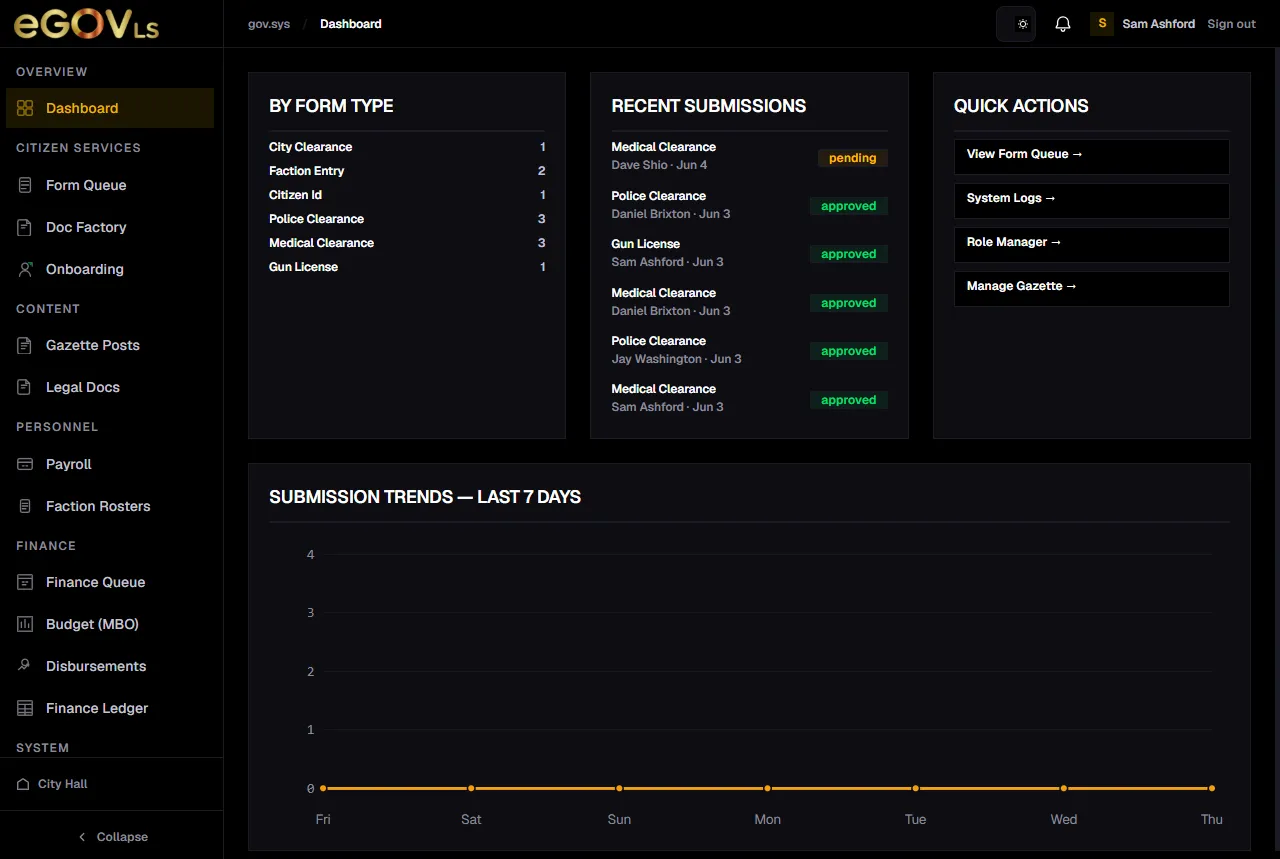
GOV.SYS is a digital governance platform for a Grand Theft Auto roleplay server community — the San Andreas government system. To be explicit about what that means: this is game infrastructure, not a government contract, and nothing here was built for a real public agency.
It exists because roleplay servers invent bureaucracy by necessity. A server with a functioning police department and a city hall accumulates real administrative load: citizen intake, budgets, personnel rosters, document requests. Left to roleplay, that load gets handled by in-character improvisation, which is entertaining right up until the point where someone needs a permit they cannot prove they hold.
Why a server needs a document system
The interesting constraint is that the population is adversarial in a way a real government is not. Players are, deliberately, trying to get something they are not entitled to. That makes the audit trail the product.
Every request gets a record, every record has a status, and a document generated from that record carries the request ID on it. When a player disputes a decision, there is an answer to point at.
What the stack is doing
- Appwrite for the data layer — documents, users, roles, and the permission model that keeps a department from editing another’s records.
- n8n for document generation and the notification chain, because the workflow is genuinely multi-step and encoding it as workflow nodes made the failure modes visible.
- Cloudinary for the media, because attachments on citizen requests are images and PDFs far more often than they are structured data.
Public transparency as a design constraint
A roleplay city hall that publishes its budgets is a roleplay city hall where the community can audit the people running it. That was a deliberate product decision, and it is the same reason real transparency portals exist: the legitimacy of the institution depends on its records being checkable by the people it governs.
The limits
It is a roleplay platform. It models governance for a community, and the parts of real governance that only matter under genuine legal compulsion — actual records retention law, actual due process, actual liability — are not modelled, because modelling them would be theatre.